Introduction
Textile manufacturers and brand owners face mounting pressure to reduce environmental impact across every stage of fiber and textile production. Water usage is one of the aspects under scrutiny. A significantly water-intensive step can be the dyeing process, with traditional bath-dyeing being the most common technology for coloring synthetic yarns.
Switching to spin-dyeing (also called dope-dyeing) gives manufacturers a concrete lever at the coloration stage. By integrating color directly into the polymer melt during fiber extrusion, spin-dyeing removes the need for a water bath, eliminates wastewater discharge, and reduces the energy required to color synthetic fibers.
Why Rethinking Your Dyeing Technology Is a Key Sustainability Enabler
The textile industry accounts for roughly 10% of annual global carbon emissions — more than all international flights and maritime shipping combined — and consumes approximately 79 billion cubic meters of water each year. Clothing production also ranks among the largest contributors to industrial wastewater pollution worldwide.
Regulatory requirements are tightening across every major market. Textile Digital Product Passports (DPP), expected under European Union (EU) law by 2027, will require manufacturers to document and disclose key information on fiber composition, manufacturing steps, and environmental footprint.
The dyeing process has a significant impact on the environmental footprint of textile products. For manufacturers of synthetic fibers, evaluating their coloration technology is an actionable step toward reducing the water and energy intensity of production.
How Does Spin-Dyeing (Dope-Dyeing) Work?
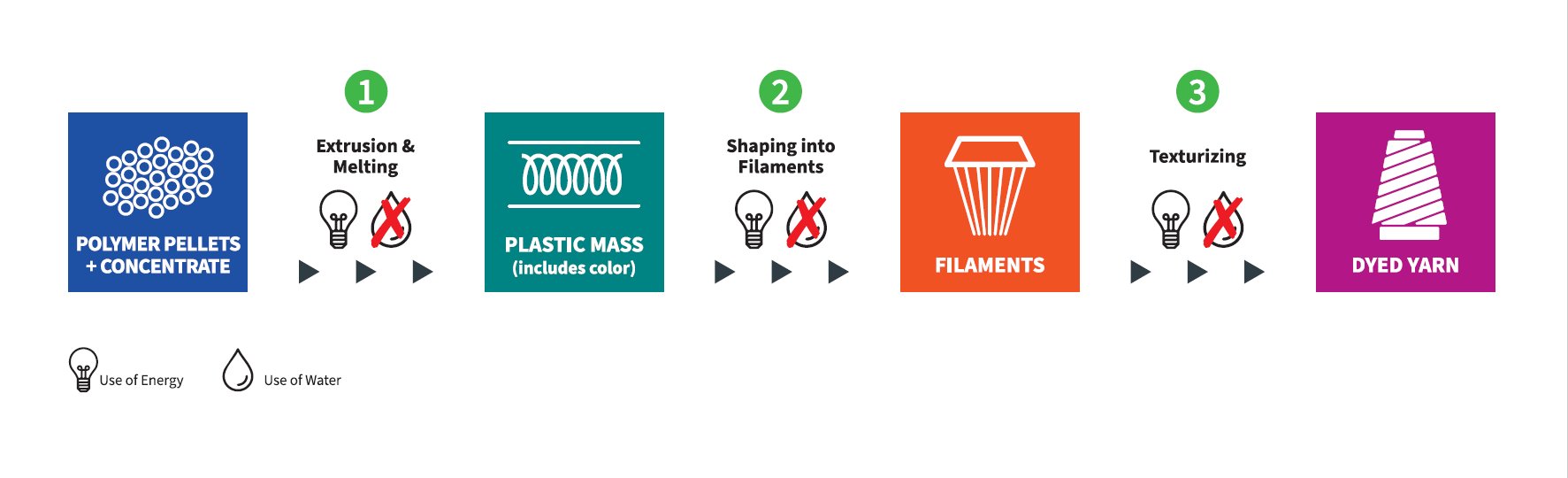
Spin-dyeing is a one-in-one dyeing technology for synthetic fibers. It colors the yarn by embedding color into the melted polymer during fiber manufacturing. Color is provided as a color concentrate (masterbatch) in pellet form. The necessary quantity of pellets is incorporated into the extruder via a dosing system or feeder. The polymer pellets and color concentrate pellets are then extruded and melted together, shaped into filaments, spun, and texturized onto bobbins.
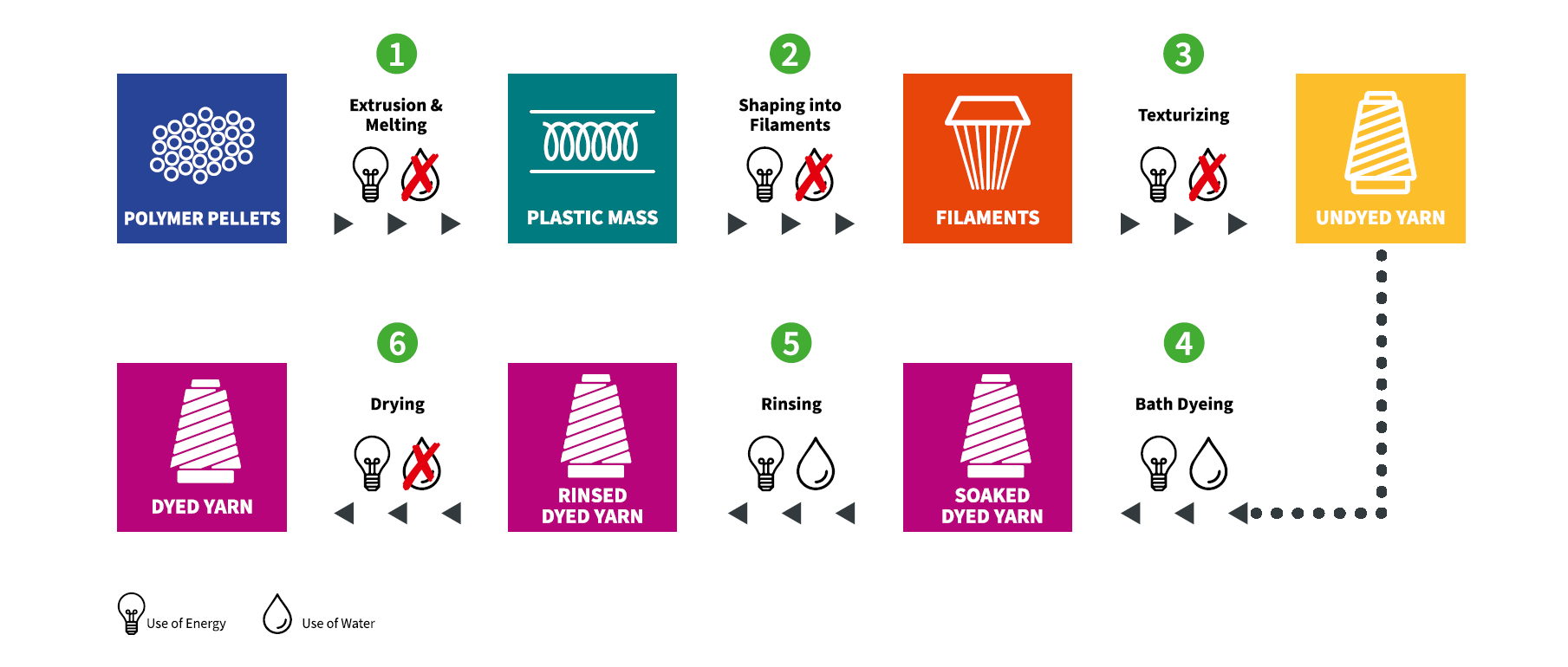
In contrast, traditional bath-dyeing is a multi-step process that includes the production of undyed yarn, submersion in water and chemicals under pressure, and rinsing and drying of the dyed yarn. Spin-dyeing requires no water, fewer steps, and less energy.
Classic bath-dyeing process
Spin-dyeing process
Watch this video to learn more about the sustainability benefits and different steps of these two dyeing processes: Sustainability Benefits of Textile Spin-dyeing Versus Traditional Bath-dyeing.
Which Fiber Types Are Compatible with Spin Dyeing?
Spin-dyeing can only be used with extruded synthetic fibers, since color is added during the extrusion manufacturing process. It is already the predominant — and currently only available — dyeing technology for polypropylene fibers. It is also a dyeing process of choice for polyester and polyamide technical fibers, where it generally delivers exemplary performance. Spin-dyeing is equally useful for recycled grades and bio-polymers, including PLA (polylactic acid) and PTT (polytrimethylene terephthalate).
Because color changes must be planned earlier in the production process than with bath-dyeing — where undyed yarn bobbins can be dyed on demand — spin-dyeing is most useful for applications without rapid color turnover. Standard brand colors, evergreen color palettes, and technical textiles are excellent candidates.
What Are the Environmental and Operational Gains of Spin-Dyeing (Dope-Dyeing)?
Compared to a classic bath-dyeing process, spin-dyeing requires no water and generates no wastewater during the dyeing step. The reduction in process steps — from six in bath-dyeing to three in spin-dyeing — directly reduces the energy load throughout the production sequence.
Color performance is a key additional advantage. Because pigment integrates throughout the fiber structure rather than coating the surface, dope-dyed fibers typically deliver excellent UV resistance, wash durability, and color consistency. These performance attributes are particularly relevant in outdoor, performance apparel and automotive textile applications.
How to Switch from Bath-Dyeing to Spin-Dyeing (Dope-Dyeing)
Transitioning from bath-dyeing to spin-dyeing requires two key equipment and process adjustments:
- Dosing equipment: Spinning lines must be equipped with volumetric or gravimetric dosing units or side-feed extruders to introduce the correct quantity of color concentrate into the extruder alongside the polymer.
- Quality control capability: A QC color department capable of assessing in- and out-of-specification criteria for dyed yarn is essential to facilitate color consistency across production runs.
Beyond equipment, production planning must account for the earlier scheduling of color changes. Unlike bath-dyeing — where undyed yarn bobbins can be dyed at a later stage — spin-dyeing locks in color at extrusion. This makes planning for color orders and production runs a critical operational adjustment.
Avient supports manufacturers through this transition, drawing on decades of masterbatch development expertise for the textile market and established relationships with fiber producers and textile associations globally. Avient’s global footprint enables local technical support throughout the switching process.
How Avient’s Fiber Spin-Dyeing Colorants Promote High Efficiency
Avient provides high-quality color concentrates specifically formulated for spin-dyeing polypropylene, polyester, polyamide — including recycled grades — and biopolymers. Dedicated fiber centers across the globe offer precise color matching and Quality Control processes to develop high-quality masterbatches with excellent spinnability, lot-to-lot consistency, and color fastness (light, washing, heat, rubbing, etc.)
Renol™ Fiber Colorants are developed specifically for polyester and polyamide (nylon) fiber applications. Remafin™ Fiber Colorants address polypropylene (PP) fibers and spunbond nonwovens. Both product families are compatible with virgin and recycled fiber-grade polymers.
Additionally, Cesa™ Fiber Additives extend the functional performance of extruded fibers. These additives address properties such as light stabilization, flame retardancy, liquid repellency, and antioxidant performance, with additional properties available on request. They also improve the spinning efficiency and mechanical properties of recycled polymer feedstocks, which can present processing variability compared to virgin materials.
How Including Fiber Taggants Supports Sustainable Fiber Coloration Claims
For brand owners who use spin-dyeing to help reduce the water and energy intensity of their textile products, Avient’s Cesa™ Fiber Tracer Concentrates offer a simple way to substantiate that claim. Combined with color in a Smartbatch™ concentrate, these taggants are incorporated directly into the yarn during extrusion, just like Renol™ and Remafin™ Fiber Colorants and Cesa™ Fiber Additives. The result is a single, streamlined masterbatch that delivers both in-fiber color and traceability in one step.
Verification is straightforward. Analytical testing on any textile or fiber sample can confirm whether the taggant is present. This identifies the fiber manufacturer and can even pinpoint the production line, linking the textile product back to manufacturers and production lines using spin-dyeing to color the yarns. This low-investment, flexible traceability solution is an easy-to-implement way to support the transparency requirements of forthcoming Digital Product Passports.
Conclusion
Textile manufacturers navigating tighter regulatory requirements and evolving brand commitments have a concrete coloration option available. Spin-dyeing eliminates water use at the dyeing stage, reduces the energy load across the production sequence and delivers color performance that meets demanding end-use requirements — all while remaining compatible with recycled polymer feedstocks and bio-polymers.
As regulatory frameworks increasingly require proof of responsible manufacturing practices, the coloration method chosen becomes part of a product’s documented environmental record.
Avient’s Renol™, Remafin™ and Cesa™ fiber product families provide the colorant and additive options needed to support a spin-dyeing transition across polyester, polyamide and polypropylene fiber applications.
Contact Avient’s technical team to discuss your next synthetic fiber coloration project and how to include in-fiber traceability in your textile products to prepare for DPP implementation.